
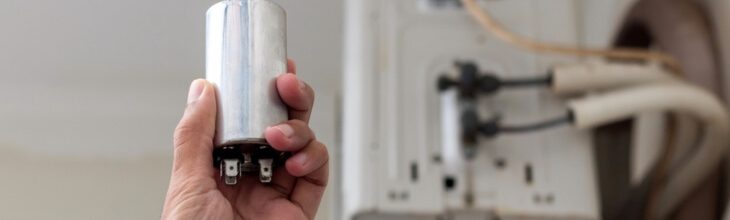
Your AC unit hums along all summer without asking for much, but every now and then, it drops hints that something is off. If your system has started clicking, humming louder than usual, or plain refusing to turn on, the culprit might be small enough to fit in your hand: the AC capacitor. Let’s get charged up and talk about it.
What is an AC Capacitor?
Think of your AC capacitor as a quick energy shot for your system’s heavy-duty motors. It is a small cylindrical canister, usually tucked inside the outdoor condenser unit, that stores electrical energy and releases a sudden jolt to jump-start your compressor and outdoor fan.
According to American Standard’s guide to AC capacitors, the capacitor delivers that initial electrical jolt when your thermostat calls for cooling. Once the motors get spinning, it keeps supplying a steady current to keep everything running smoothly throughout the cooling cycle. Most systems use a combination of start and run capacitors (or a single “dual-run” capacitor) to handle this heavy lifting.
Small part, big job. When it fails, your entire system can feel the shock (pun fully intended).
Signs Your AC Capacitor Is Going Bad
Capacitors rarely fail without warning. Keep an ear and eye out for these clear red flags:
- The AC won’t turn on at all: You hear a faint click from the thermostat, but the outdoor unit stays silent. Without that initial charge, the compressor can’t start.
- The unit short cycles: The system turns on and off repeatedly. A failing capacitor struggles to hold the steady charge required to finish a full cooling cycle.
- Loud humming from the outdoor unit: A quiet hum is normal, but a loud, strained buzz means the motor is trying to run without enough starting power.
- The AC runs but doesn’t cool: If the fan spins but the capacitor connected to the compressor fails, your system will push warm air throughout your home.
- Higher energy bills: A weak capacitor forces your motors to pull more electricity to operate, driving up utility costs.
- Visible physical damage: A swollen, bulging top, cracked casing, or oily liquid leaking from the capacitor means it has suffered catastrophic internal failure.
If any of this sounds familiar, check out our post on why your air conditioner keeps turning on and off or what’s behind those strange air conditioner noises for a deeper dive into related symptoms.
🚨 The R-22 Phase-Out: Is Replacing the Capacitor Worth It?
If your home’s air conditioner is an older model running on R-22 refrigerant (Freon), pay close attention to how often electrical parts fail. Under EPA regulations, R-22 production and importation have been completely phased out, making refrigerant recharges prohibitively expensive.
When older R-22 systems reach the end of their lifespan, tight, aging compressor bearings create high electrical resistance. This excess strain often causes the unit to repeatedly blow dual-run capacitors. If an older system keeps destroying capacitors, replacing them over and over is usually just masking a dying compressor. Investing in a modern, energy-efficient system is often a far better long-term decision than constantly repairing an obsolete R-22 unit.
DIY vs. Pro Maintenance: Where to Draw the Line
While basic preventive maintenance is great for handy homeowners, working near high-voltage components requires strict boundaries.
How to Test and Replace an AC Capacitor (And Why to Think Twice)
A technician tests a capacitor using a multimeter set to measure capacitance in microfarads (μF), comparing the reading to the rating printed on the canister. If the reading falls outside the safe range (usually ±5%), it must be replaced.
Here is where we put on our serious hat: capacitors retain dangerous electrical energy even after power is shut off at the breaker. Replacing one involves turning off power, safely discharging the residual stored voltage, disconnecting high-voltage wiring, and matching the exact microfarad and voltage specifications.
One wrong move around a charged capacitor can mean anything from a painful shock to permanently frying your expensive compressor motor or main circuit board. This is not a DIY project to learn on a Saturday afternoon.
When to Call an HVAC Professional
If your AC is short cycling, humming louder than usual, or not turning on at all, it’s time to call in a professional rather than reach for a screwdriver. A licensed technician can test the capacitor safely, confirm it’s actually the problem (rather than a different electrical issue wearing a capacitor’s disguise), and replace it correctly the first time. Routine maintenance also goes a long way toward catching a failing capacitor before it leaves you sweating. As the U.S. Department of Energy notes, regular maintenance extends the life of your air conditioner and helps it run as efficiently as possible.
Don’t let a bad capacitor short-circuit your comfort. If your AC is acting up, give Complete Air Mechanical a call and let our team get your system back in charge.
Call us today at (407) 915-0144 or schedule an appointment online.